

Commercial PVC Roofing Systems

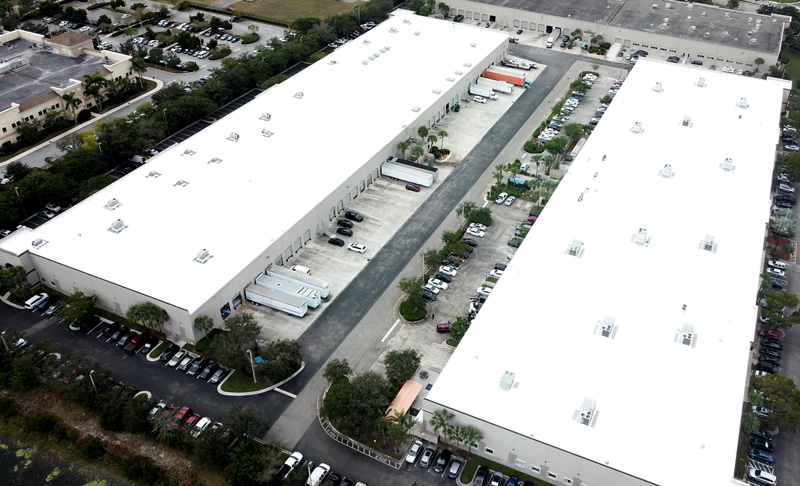
What is PVC roofing? PVC (polyvinyl chloride) roofing is a single-ply thermoplastic membrane used on low-slope commercial roofs. Seams are heat-welded into one continuous waterproof surface, and the membrane resists grease, oils, and chemicals, which makes it a top choice for restaurants, food processing plants, healthcare facilities, and manufacturing sites. It also suits warehouses and distribution centers, where a reflective white membrane helps control cooling costs across large roof areas. North American Roofing installs, repairs, and maintains PVC roof systems in 49 states.
Request a quote or talk to a PVC specialist at (800) 551-5602.
The PVC single-ply membrane with triple bottom line benefits.
PVC roofing offers a proven combination of durability, energy efficiency, and environmental performance. Designed to withstand the toughest conditions, these systems resist oil, grease, and chemical exposure, making them especially effective for restaurants, airports, and other commercial facilities with demanding environments. White reflective PVC roofing panels also deliver the cooling benefits building owners want, helping to lower energy costs in warmer climates while supporting LEED credits and Energy Star recognition. With more than 45 years of successful industry use and compliance with the most rigorous building codes, PVC roofing provides a long-term, cost-effective solution that is both easy to maintain and simple to repair.
Why PVC Roofing is an Industry Standard
Put simply, PVC is engineered to stand the test of time. Durable, yet pliable, PVC is an ideal long-term roofing solution, available with fleece backing and in thicknesses up to 80 mil. The thicker the membrane, the greater its resistance to breakage, tears, water absorption, and weathering. Manufactured to stringent standards, PVC membrane comes with plasticizer bonding agents, polyester reinforcement, and UV protectants. And its large membrane sheets mean it’s easy to install, with fewer seams in need of protection.
A Long Name with a Longer List of Benefits
Thermoplastic polyvinyl chloride membrane has a very affordable commercial life-cycle cost when compared with other roofing membranes. As mentioned, PVC retains a high reflectivity value over time, offering continued energy efficiency and optimal solar reflectance index (SRI). Roofs that are frequently exposed to grease or chemicals, such as restaurants and food processing facilities, benefit from the protection afforded by a PVC roofing system. Puncture resistance and strong seam bonding provide excellent waterproofing protection.
PVC is a solid option for restaurants, airports and commercial facilities with grease, oil, and chemical concerns, and environments that experience dilute acidic effluents. White reflective PVC roofing panels have a surface that provides a cooling effect that owners desire to provide energy savings in warmer climates. It has been tested in the industry for more than 45+ years and now meets the most stringent codes in a wide variety of climates.
Installation Options
PVC can be fully adhered or mechanically fastened, and is suitable for use with the RhinoBond mechanical attachment system. Induction welding of PVC membrane electromagnetically seals the underside of the membrane to specially coated plates in a grid pattern. For enhanced wind uplift resistance, a dense grid pattern is used. PVC is suitable for new roof installation or as a cost-effective reroofing solution.
PVC is a solid option for restaurants, airports and commercial facilities with grease, oil, and chemical concerns, and environments that experience dilute acidic effluents. White reflective PVC roofing panels have a surface that provides a cooling effect that owners desire to provide energy savings in warmer climates. It has been tested in the industry for more than 45+ years and now meets the most stringent codes in a wide variety of climates.
Our Major Manufacturer Partners
Choosing the highest-quality PVC roofing system is an absolute necessity for the success and longevity of your roof. North American Roofing partners with all major manufacturers to bring you the best roofing products around. They include:
PVC Roofing at a Glance
| Attribute | Typical PVC Specification |
|---|---|
| Membrane type | Single-ply thermoplastic, polyester or fiberglass reinforced |
| Thickness | Commonly 50, 60, and 80 mil |
| Seam method | Hot-air welded (chemically and thermally fused, no adhesives at the seam) |
| Attachment | Fully adhered, mechanically fastened, or induction welded (RhinoBond) |
| Chemical resistance | Excellent against animal fats, oils, and many rooftop chemicals |
| Reflectivity | White and light colors, Energy Star and cool-roof rated options |
| Best for | New construction, re-roofs over compatible existing systems, grease-exposed roofs |
PVC vs. TPO vs. EPDM
| PVC | TPO | EPDM | |
|---|---|---|---|
| Seams | Heat-welded | Heat-welded | Tape or adhesive |
| Grease and chemical resistance | Excellent | Moderate | Poor to moderate |
| Reflectivity | High | High | Low (black) unless coated |
| Upfront cost | Higher | Mid | Lower |
| Best fit | Restaurants, food plants, hospitals, chemical exposure | General commercial, budget-sensitive cool roofs | Large, simple roofs in cold climates |
Not sure which system fits your building? See our guide to TPO roofing or review all commercial roofing systems.
When PVC Is the Right Choice
- Grease or chemical exposure: restaurants, commercial kitchens, food processing, and plants with rooftop exhaust.
- Hot climates: reflective white membranes cut cooling load, relevant across Florida and the Southeast.
- High-wind regions: fully adhered or induction-welded systems with a tighter fastening pattern improve uplift resistance.
- Long-term ownership: welded seams and manufacturer warranties favor owners who plan to hold the building.
- Warehouses and distribution centers: large, low-slope roofs where a reflective white membrane lowers cooling costs in conditioned space and welded seams reduce leak points.
When another system may fit better: tight budgets with no chemical exposure often point to TPO, and very large simple roofs may favor EPDM. We recommend the system after a roof survey, not before.
PVC Roofing FAQ
How long does a commercial PVC roof last?
Many PVC roofs last 20 to 30 years or more with routine inspection and maintenance. Actual life depends on membrane thickness, installation quality, climate, and rooftop foot traffic or exhaust exposure.
Is PVC better than TPO?
Neither is better in every case. PVC outperforms TPO where the roof is exposed to grease, oils, or chemicals. TPO usually costs less and works well for general commercial buildings without that exposure.
Can PVC be installed over an existing roof?
Often yes, if the existing system is dry and compatible, usually with a separation layer or cover board. A moisture survey tells us whether a recover is safe or a tear-off is needed.
What does PVC roofing cost?
Cost depends on roof size, membrane thickness, insulation, attachment method, tear-off needs, and access. PVC typically costs more upfront than TPO or EPDM and returns value through durability and seam performance. Request a quote for a number specific to your building.
Is PVC roofing energy efficient?
Yes. White and light PVC membranes reflect sunlight, reduce rooftop heat, and can support Energy Star, cool-roof, and LEED goals.
Where does North American Roofing install PVC roofs?
We are licensed to serve 49 states, with deep coverage across Florida and the Southeast including Tampa, Orlando, Jacksonville, Miami, Atlanta, Nashville, Raleigh, Charlotte, Birmingham, and Memphis. See our locations.
Get a PVC Roofing Quote
Tell us about your building and we will recommend the right system.
Request a quote | Talk to a PVC specialist: (800) 551-5602 | 24/7 emergency: (866) 567-2064